












sample books
 packaging
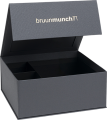 magnetic boxes
 drawer boxes
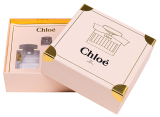 rigid box with lid
 cuffed boxes
 slipcase boxes
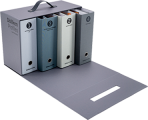 suitcases and chests
 clamshell boxes
 oblique boxes
 round tube boxes
 flat-folding boxes
 folder BOX
 decorative boxes
 chocolate boxes
 cosmetics boxes
 gift boxes
 alcohol and wine boxes
 boxes for CBD
 boxes with a window
 eco friendly boxes
 jewellery boxes
 binders
 folders
 clipboards
 stands
- premium products
 eco products
- other
2-Ring or 4-Ring Mechanism? How to Choose the Right Ring Binder Mechanism?
A poorly chosen ring mechanism is a silent sabotage of documentation – it damages page edges, deforms the contents, and hinders a seamless presentation of the offer to the client. Choosing the binder mechanism is a matter of engineering, not aesthetics: the distribution of forces acting on the pages, the weight of the contents, and the frequency of page-turning determine which mechanism will actually do the job. In the B2B segment, where promotional binders serve as a company's business card, a mistake can be costly.
2-Ring Mechanism – A Classic with Precision Application
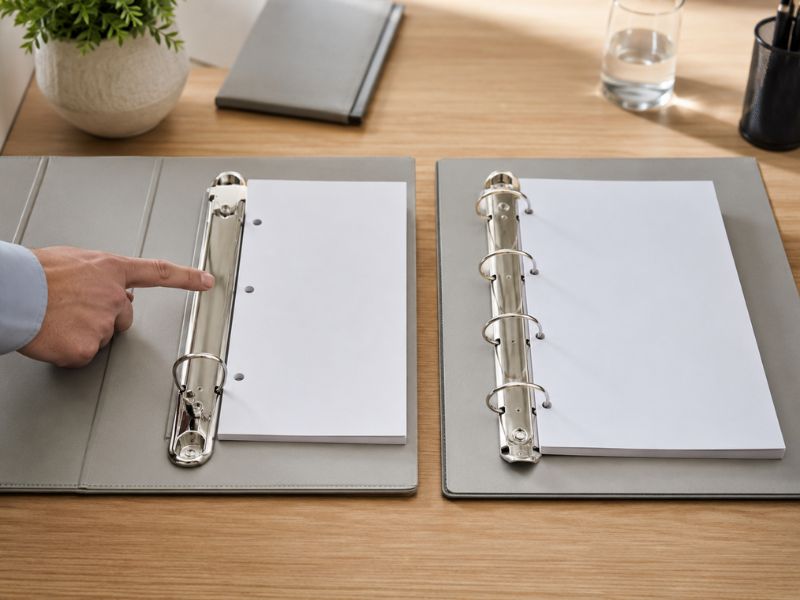
The 2-ring mechanism is a proven solution for standard office applications.
Its main advantage is its ease of use – two attachment points allow for quick opening and closing, which results in efficient page-turning during work meetings.
It works best when:
- the contents do not exceed standard paper weights (80–100 g/m²),
- the binder is used for storing text documents, printouts, or invoices,
- the user accesses it regularly, but without intensive, repeated reviewing of the same set of materials.
The limitation of the 2-ring mechanism is the uneven distribution of forces with heavier contents – the pages sag asymmetrically, leading to their excessive wear and tear at the rings.
4-Ring Mechanism – Stabilization Under Load
Four support points are the key advantage of the 4-ring mechanism in demanding applications.
With thick sample cards, materials on coated paper, or multi-page catalogs, the even weight distribution of the contents eliminates the problem of pages sagging and tearing at the edges.
In practice, the 4-ring mechanism dominates wherever the binder serves as a carrier for a product offering or a sample book – materials are presented multiple times, the contents are heavy, and aesthetics have a direct impact on brand perception. A binder manufacturer offering solutions for industries that operate with sample books should consider the 4-ring mechanism as a minimum standard.
Round Rings (Type R) vs. D-Rings (Type D) – The Importance of Geometry
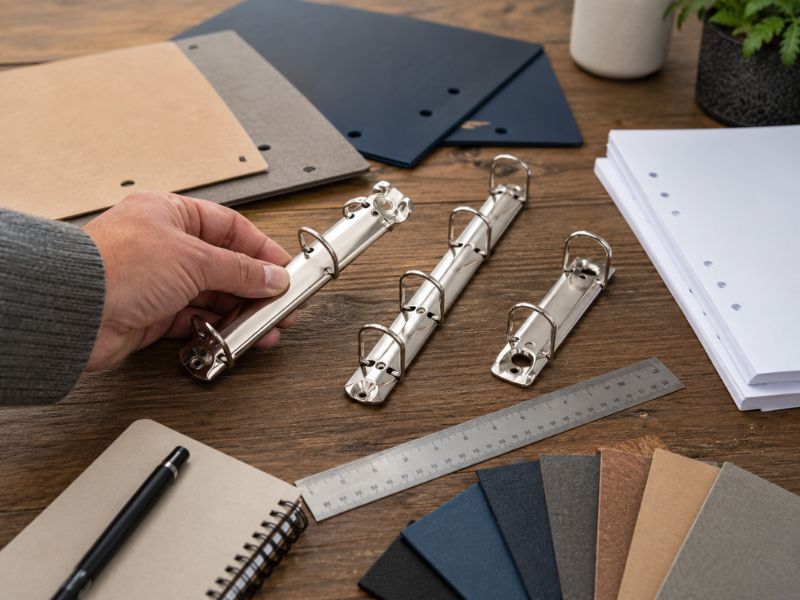
The shape of the ring determines how the pages lie in the stack and how much material actually fits into the spine:
Round Rings (Type R)
In round rings, the contents lie loosely, but under full load, the pages bend in an arc, reducing the effective capacity of the spine by up to 20–30%.
D-Rings (Type D)
The flat side of the ring lies flush against the spine, allowing for an even alignment of the paper stack, full utilization of the binder width, and easier page-turning.
For promotional binders intended for intensive use, the ring mechanism with D-rings ensures better ergonomics and a longer lifespan for the contents.
Three Criteria for Choosing the Binder Mechanism in Practice
The choice of the ring mechanism should be based on three technical parameters:
- Frequency of page-turning – the higher it is, the greater the need for stabilization (Type D, 4 rings),
- Content paper weight – materials above 150 g/m² require a 4-ring mechanism,
- Binder mobility – a binder used in the field or during presentations at a client's location should have a lever arch mechanism with a locking function to minimize the risk of accidental opening.
The solid board used for the binder body reinforces the entire construction but does not compensate for a poorly chosen mechanism – it is the ring mechanism that determines the durability of the entire system.
Choosing the Mechanism is a Design Decision – Do Not Leave It to Chance
The ring mechanism is an element that is easily trivialized when ordering office or promotional binders. In the meantime, it is precisely this mechanism that determines whether the product received will be a reliable tool for years to come or a source of problems after just the first presentation season.
If you are planning an order for corporate binders and want to ensure that the ring mechanism is optimally matched to the intended contents – consult the technical parameters with MILO's design department. Our specialists will advise you on the choice of mechanism, spine width, and ring type, taking into account the specifics of your contents and how the binder will be used.
Would you like to order durable and aesthetic binders?
Contact us!
MILO Group
- +48 71 322 14 44
- info@milogroup.eu
- ul. Stawowa 7-9, 55-002 Dobrzykowice - Wrocław, Poland


© Grupa MILO. Wykonanie: 
sample books
- packaging
- magnetic boxes
- drawer boxes
- rigid box with lid
- cuffed boxes
- slipcase boxes
- suitcases and chests
- clamshell boxes
- oblique boxes
- round tube boxes
- flat-folding boxes
- folder BOX
- decorative boxes
- chocolate boxes
- cosmetics boxes
- gift boxes
- alcohol and wine boxes
- boxes for CBD
- boxes with a window
- eco friendly boxes
- jewellery boxes
- binders
- folders
- clipboards
- stands
- premium products
- eco products
- other